
Commercial exposure rarely appears at the moment a fixture is agreed. It builds once the vessel is moving: a speed order conflicts with the consumption warranty, worsening weather is poorly evidenced, or an ETA update misses a contractual notice window.
Table of Contents
A charter party is the contract between a shipowner and a charterer governing the use or employment of a vessel. It defines the charter type, payment terms, operational responsibilities, performance obligations and allocation of commercial risk. “Charterparty” and “charter-party” are alternative spellings of the same term.
The definition is straightforward. The operational challenge is knowing what the agreement requires today, while the vessel is sailing and there is still time to act.
What is a charter party agreement in shipping?
A charter party is the contractual rulebook for a shipping fixture. Depending on the arrangement, the owner may agree to carry cargo on a specified voyage, make the vessel’s services available for a period, or transfer possession and operational control under a bareboat charter.
The agreement identifies what each party has promised, who controls each decision and who bears the associated cost, time and risk. Typical provisions cover vessel condition and performance, cargo and trading limits, freight or hire, bunkers, routing, ports, notices, laytime or off-hire, emissions obligations, claims evidence and dispute resolution.
In practice, the charter party is often a contractual stack rather than a single document. It may comprise a fixture recap, a standard form, rider clauses, addenda and later amendments. Parties might begin with BIMCO’s GENCON 2022 for a voyage charter, NYPE 2015 for a time charter or BIMCO’s BARECON 2017 for a bareboat charter, then modify the printed terms extensively through riders.
For the operations desk, version control is therefore a commercial control. The team must know which form and edition applies, which riders amend it, whether all subjects have been lifted and which document prevails if provisions conflict.
Chartering and a charter party are not the same thing
The terms are related, but they describe different parts of the commercial process.
Chartering is the wider activity: identifying suitable tonnage or cargo, exchanging offers and counteroffers, negotiating freight or hire, lifting subjects, fixing the vessel and managing its employment.
The charter party is the contract created by that process. Chartering creates the fixture; the charter party governs its performance.
The fixture recap matters because it records the headline terms agreed during negotiation. Under English law, and depending on the wording and any outstanding subjects, a binding agreement may arise before the long-form charter is signed. Contract-formation rules vary by jurisdiction, so operators should work from the complete contractual stack, not whichever attachment happens to be newest in the email chain.
A charter party is also distinct from a bill of lading. The charter party generally governs the owner & charterer relationship. A bill of lading acknowledges receipt of the cargo and may evidence or constitute the contract of carriage with cargo interests. A negotiable bill may also operate as a document of title, depending on its form and applicable law; a sea waybill does not. Only specified charter-party terms may be incorporated. Treating the documents as interchangeable can create a gap between obligations owed to the charterer and those owed to the lawful bill holder.
The main types of charter party
Charter type determines who controls the main commercial levers, who pays the principal voyage costs and where disputes are most likely to arise. The allocations below are typical, not universal; the agreed wording always prevails.
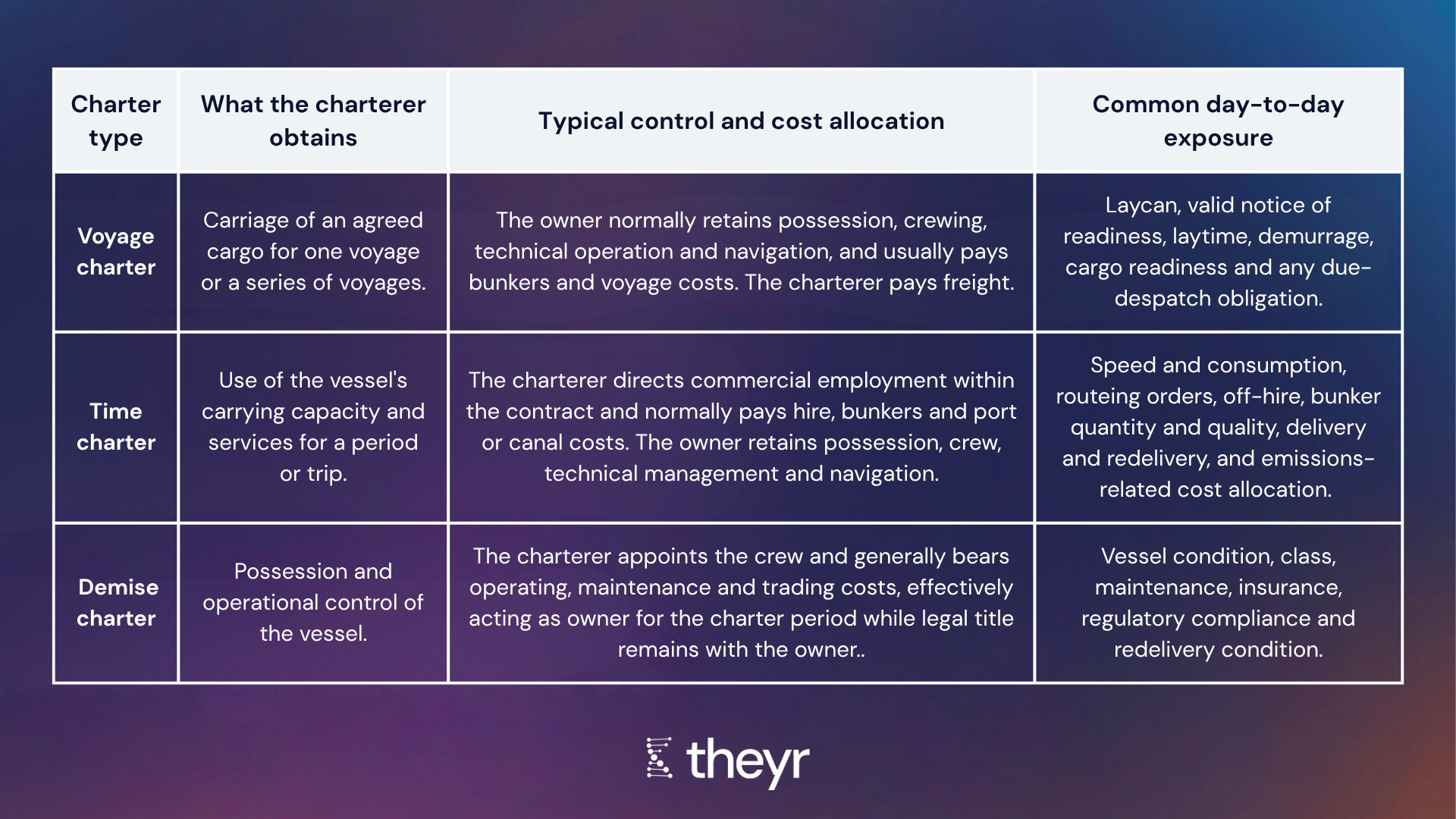
For a deeper comparison of control, fuel and compliance, see Voyage charter versus time charter.
What does a charter party agreement include?
No two fixtures are identical, but most charter parties answer a recognisable set of commercial and operational questions:
- Who are the contracting parties, and is any obligation guaranteed?
- Which vessel, cargo, voyage, period or trading range is covered?
- What is warranted about the vessel’s description, condition, capacity and performance?
- How much freight or hire is payable, when is it due, and what deductions or remedies are permitted?
- Who pays for bunkers, port costs, cargo handling, canal dues and emissions-related costs?
- Who may issue employment, routeing and speed instructions, and what remains subject to the Master’s authority over navigation and safety?
- What are the delivery, cancelling and redelivery windows and locations?
- Which notice requirements, evidence rules and claim time bars apply?
- How are delay, breakdown, unsafe ports, deviation, war, sanctions and other exceptional events allocated?
- Which law governs the contract, and where must disputes be resolved?
The printed form is only the starting point. Recap terms and riders often contain the commercially decisive changes. A useful operational summary records every agreed variable alongside the clause and source document from which it came.
Charter party clauses that create day-to-day exposure
Not every clause belongs on an operator’s daily screen. The terms below are the ones most likely to change a route, speed, ETA, fuel decision, port call or claims record. Theyr’s separate guide examines five clauses with direct voyage optimisation implications in more detail.
Speed, consumption and good-weather performance
Speed and consumption warranties sit where vessel performance, weather and money meet. Headline figures are only the start. The clause may distinguish ballast from laden condition, specify draught, fuel grade or engine setting, qualify figures with “about”, and define the wind, sea, swell and current conditions that count as good weather.
The practical question is rarely whether the vessel averaged the headline speed across the entire passage. It is which periods qualify under the agreed weather definition, which allowance applies and how conflicts between vessel logs and weather routing data should be handled. There is no universal Beaufort threshold or standard allowance that can safely be applied to every fixture.
Keep time-aligned records of track, speed, power, fuel, vessel condition and weather. Do not confuse a performance claim with off-hire: as West P&I explains, the two apply different contractual tests and can produce different outcomes.
Routeing, speed orders, ETA and deviation
Under a conventional time charter, the charterer directs commercial employment while the Master remains responsible for navigation and safety. Routing and speed instructions must be read alongside trading limits, weather-routing provisions and machinery restrictions. Preserve the original order, the information available when it was issued, the Master’s response and the reason for any departure.
A routine ETA is not automatically a guarantee. Cancellation rights usually arise under the cancelling clause if the vessel fails to meet the agreed readiness requirements by the cancelling date. Damages generally require a separate breach, for example, of an expected-readiness, due-despatch or notice obligation. The voyage record should also explain any departure from the shortest route and quantify its effect on time and fuel.
Laycan, Notice of Readiness, laytime and demurrage
These voyage-charter concepts are closely connected but should not be confused:
- Laycan is the window between the first layday and the cancelling date during which the vessel must satisfy the charter’s readiness or presentation requirements. Missing the cancelling date normally gives the charterer a contractual option to cancel; it does not automatically create a damages claim.
- Notice of Readiness (NOR) tells the relevant party that the vessel has arrived at the contractually required place and is ready for cargo operations. A notice sent too early, to the wrong party, or before the vessel is physically and legally ready may fail to start laytime. Wording such as WIBON, WIPON, WIFPON or WCCON may modify the required place or formalities.
- Laytime is the agreed period for loading or discharge. Demurrage is payable for qualifying delay after laytime expires; an exception that stops laytime may not stop demurrage.
Despatch, where agreed, is paid for time saved. Reconcile the NOR, proof of receipt, cargo times, interruptions and signed statement of facts while the port call is still fresh.
Hire and off-hire
Under a time charter, hire ordinarily runs from delivery to redelivery unless the off-hire clause is engaged. Delay alone does not place the vessel off-hire, and owner fault is not always required. The test may require a listed event, prevention of the service then required and measurable time lost; some clauses apply a net-loss test, while others operate for a defined period. Record the failure, required service, cause, repair activity and actual schedule impact. The West P&I off-hire guide explains why the individual wording matters
Bunkers and remaining on board
Under a typical time charter, the charterer supplies and pays for bunkers; under a voyage charter, bunkers are usually for the owner’s account. The charter may also regulate grades, specifications, sampling, testing, segregation, off-specification fuel, and the quantity and valuation of bunkers remaining on board at delivery and redelivery. Connect bunker delivery notes, retained samples and laboratory results to tank allocation, changeovers, grade specific consumption and ROB measurements.
Safe ports, safe berths and trading limits
Never assume a safe-port or safe-berth obligation exists; its scope depends on the agreement. Where a warranty applies, safety is assessed for the particular vessel at the relevant time. Draught, tides, pilotage, terminal restrictions, forecasts, security and sanctions information all belong in the decision record. War, piracy, ice and sanctions clauses may also change whether an order must be followed and who bears the additional cost. An efficient route is commercially useless if it breaches trading limits or makes the order unsafe.
CII, EU ETS and FuelEU Maritime
Environmental regulation now shapes charter-party drafting as well as statutory reporting. The IMO Carbon Intensity Indicator (CII) is an annual operational rating for covered vessels; a contractual voyage projection is not the vessel’s statutory annual CII rating.
Under the EU ETS, the regulated shipping company surrenders allowances to the authority, while the charter party allocates data, transfer and reimbursement obligations between the parties. For emissions generated in the 2026 reporting year, the phase-in reaches 100% of emissions within scope, with methane and nitrous oxide included alongside carbon dioxide. The scope covers 100% of intra-EEA and in-port emissions and 50% of qualifying extra-EEA voyage emissions. Allowances for 2026 emissions are surrendered in 2027; the 2026 surrender obligation for 2025 emissions remains at 70%.
FuelEU Maritime regulates the annual average lifecycle greenhouse-gas intensity of energy used on board covered ships above 5,000 GT calling at EU ports, subject to the regulation’s scope and exemptions. The charter may allocate fuel documentation, compliance-balance data, surcharges and pooling decisions. Fuel, route, speed and waiting time can therefore affect both regulatory exposure and the commercial bargain.
Governing law, arbitration, evidence and time bars
Even a strong operational record can fail if the claim is late or omits required documents. Capture the governing law, arbitration forum, notice addresses, documentary requirements and time bars at the outset. Preserve time zones, original inputs, corrections, calculation versions and approvals so the evidence can be tested against the charter’s definitions and deadlines.
What shipping operators need to track
Convert the contract into a working control sheet before the voyage begins. At minimum, each critical obligation, notice, data point and decision should have a named owner, an evidence source, a deadline and a clear escalation threshold.
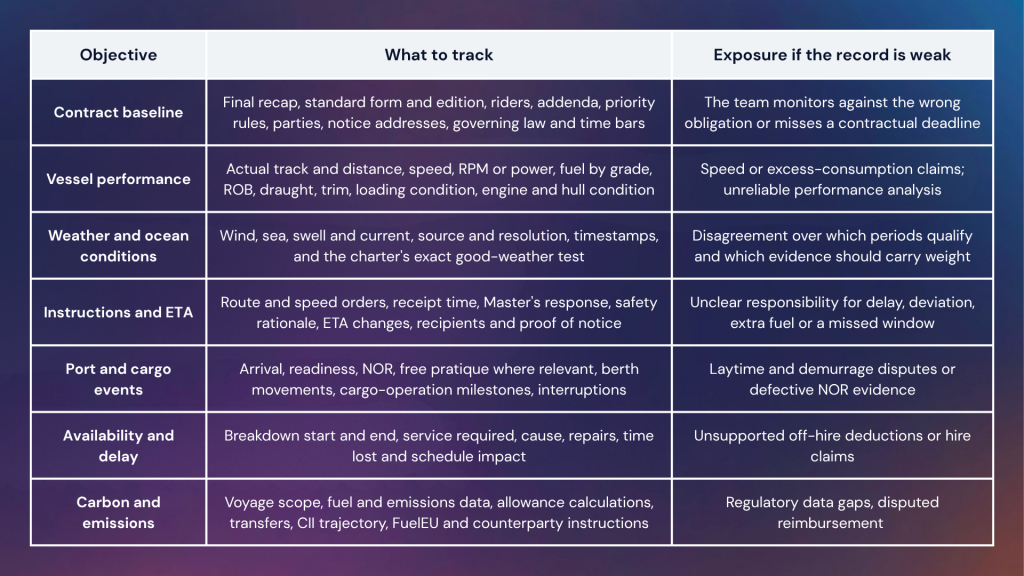
Bringing charter-party terms into voyage decisions
Charter-party terms must be brought into the voyage decision itself. If guaranteed speed, fuel consumption and good-weather qualifications remain buried in a PDF, the team may not see the conflict between an efficient route and the contracted performance basis until the voyage is over.
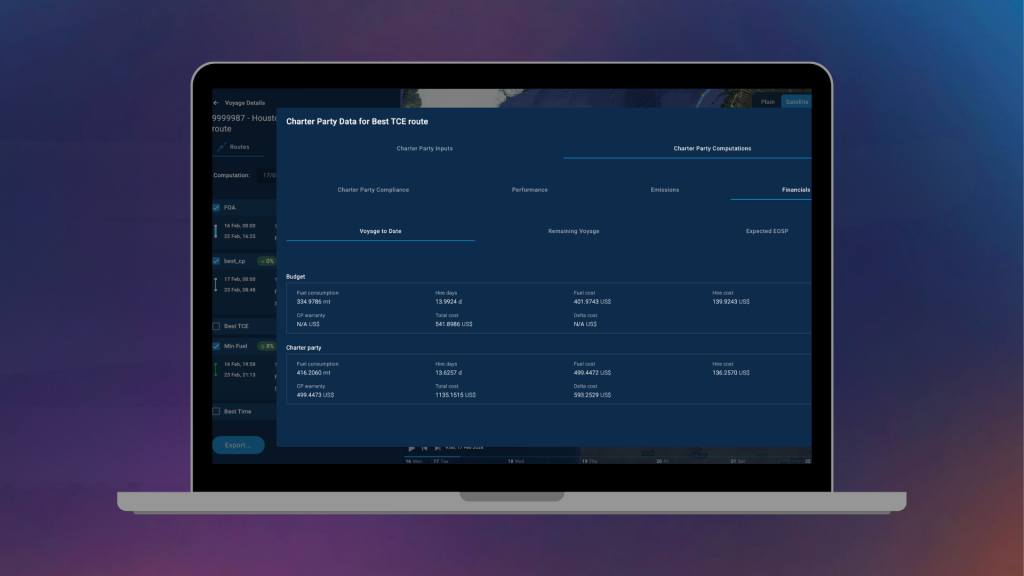
The T.VOS Dynamic Charter Party Module, developed through collaboration between Theyr and Rensmarine, is designed to close that gap. Its charter-party algorithm converts selected performance and financial terms into computational inputs, while T.VOS assesses them within a multi-objective voyage-optimisation framework.
During planning, agreed speed and consumption parameters, good-weather definitions, other weather qualifications and relevant commercial provisions can be assessed alongside vessel characteristics, cargo requirements, port constraints, fuel, transit time, ETA, emissions and TCE. Route and speed options can therefore be compared for both technical efficiency and their projected position against the selected charter-party parameters.
Once the vessel is under way, actual position, speed, fuel consumption and encountered weather update the voyage assessment. As new data arrives, the projected end-of-sea-passage position can be refreshed up to four times a day. Operators can identify emerging speed, consumption or time exposure while alternatives remain available, and compare the implications of different owner and charterer priorities.
For maritime technology providers, T.VOS offers an CP API to offer contract-aware decision support into an existing platform. It does not interpret the full charter party, determine liability or replace legal and claims expertise. Its purpose is practical: connect selected operational terms to route, speed, fuel, weather, ETA and emissions early enough to support action.
Voyage optimisation cannot rewrite the contract. It can make the contract’s operational consequences visible sooner.
Charter party compliance starts before the vessel sails
Effective charter-party management begins with the correct document set and clear ownership of the data, notices and decisions that matter. The commercial position should then be revisited whenever route, speed, weather or ETA changes, not reconstructed after the voyage.
For maritime technology providers, this means treating charter-party exposure as part of voyage decision-making rather than as a separate end-of-voyage report.
Explore T.VOS to see how multi-objective voyage optimisation can bring fuel, time, emissions and selected charter-party performance parameters into one operational view.
Frequently Asked Questions (FAQs)
What is a charter party agreement in shipping?
A charter party is the contract between a shipowner and a charterer governing the use or employment of a vessel. It sets out payment, responsibilities, performance obligations and the allocation of cost and risk. The complete agreement may include a fixture recap, standard form, riders and addenda.
What is the difference between chartering and a charter party?
Chartering is the commercial process of finding a vessel or cargo, negotiating freight or hire and fixing the business. The charter party records the resulting bargain and governs how it is performed.
What are the three main types of charter party?
The three principal types are voyage, time and bareboat (or demise) charter. A voyage charter covers carriage on an agreed voyage; a time charter gives the charterer commercial employment of the vessel for a period; and a bareboat charter transfers possession and operational control to the charterer.
Can voyage optimisation software support charter party compliance?
Yes, where the software converts selected operational terms into structured inputs and compares them with updated voyage data. T.VOS assesses agreed speed, consumption, weather and commercial parameters alongside route, fuel, ETA, time and emissions. It highlights projected exposure; it does not determine legal liability or guarantee compliance.