
Table of Contents
A vessel can save fuel and still deliver the wrong commercial outcome. The lowest-consumption route may miss a berth window, weaken the vessel’s position against speed and consumption warranties, or reduce time charter equivalent (TCE). The fastest route may protect ETA, but increase bunker cost, emissions and avoidable waiting.
Multi-objective voyage optimisation addresses the voyage as it actually exists: a moving commercial decision shaped by route, speed, timing, weather, vessel performance and contractual obligations. Instead of producing one supposedly perfect answer, it identifies a set of viable alternatives and makes the trade-offs between them explicit. As forecasts, port conditions, vessel performance or instructions change, the decision can be recalculated.
What is multi-objective voyage optimisation?
Multi-objective voyage optimisation searches for voyages that perform strongly across two or more competing objectives. These may include minimum fuel, shortest voyage time, a required ETA, just-in-time arrival, lower emissions, an improved Carbon Intensity Indicator (CII) outcome, better TCE and optimum charter party compliance.
These outcomes rarely improve together. Slowing down may reduce fuel burn but can jeopardise delivery. Speeding up may protect cargo availability while eroding TCE once additional bunker and carbon costs are included. A weather-avoidance route may be longer, yet safer and more reliable.
There is therefore seldom one route that is best on every measure. The valuable output is a set of defensible choices and clear evidence of what is gained and sacrificed for each route.
Why is minimum fuel not enough
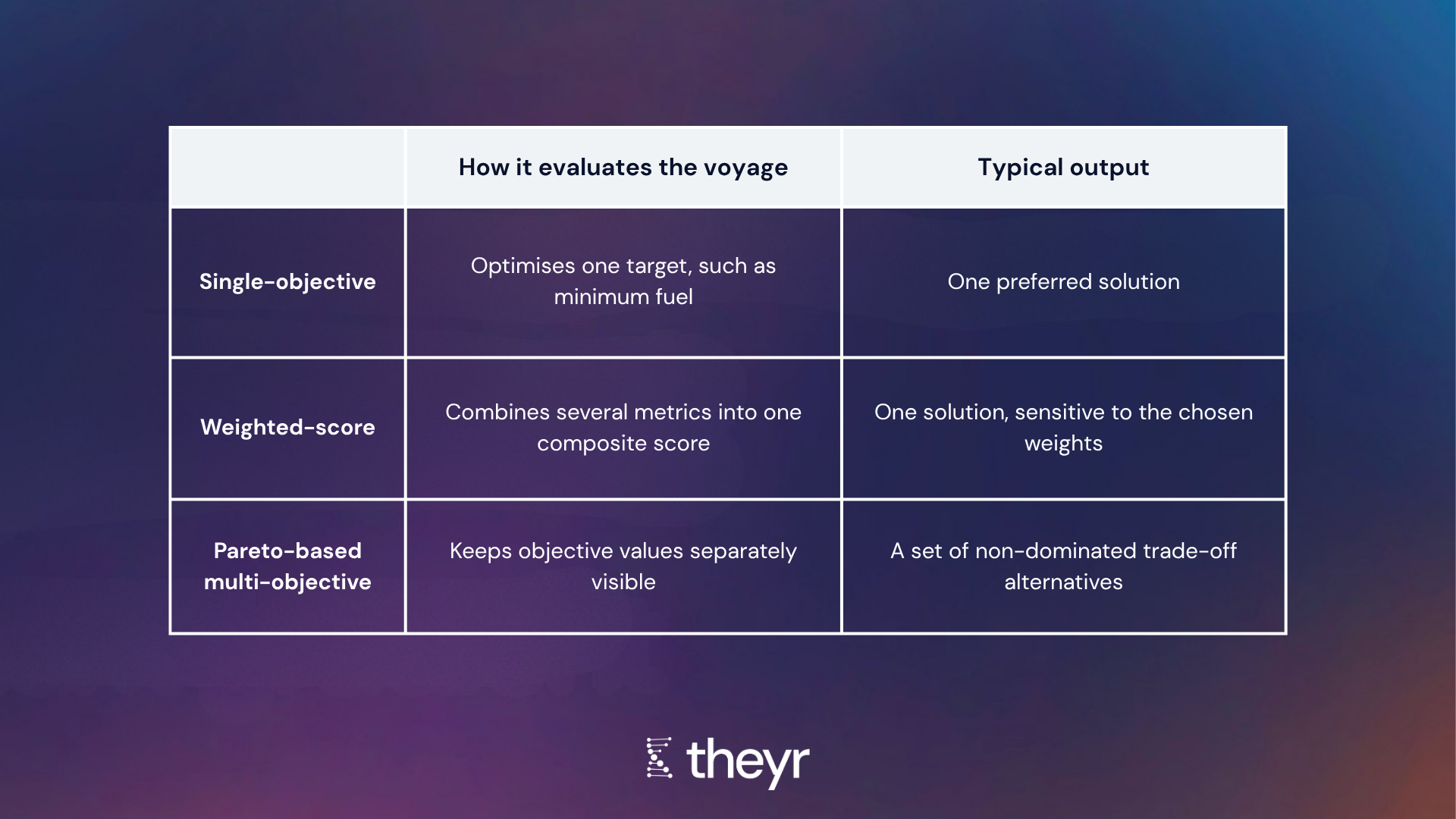
A single-objective optimisation answers a narrow question: which feasible voyage uses the least fuel, takes the least time or performs best against one selected metric?
Consider two routes that each consume 500 tonnes of fuel, while one takes approximately 450 hours and the other 350. A fuel only calculation treats them as equal, despite the major difference in vessel availability and voyage economics. The same weakness appears when a minimum-fuel route misses an arrival or laycan window, a fastest route arrives before the berth is ready, or a lowest-emission route creates charter party exposure.
A possible workaround is to combine multiple objectives into a weighted score. This can be useful when the weights are transparent and stable. In practice, however, the value of an hour, a tonne of fuel or a unit of carbon exposure varies by voyage and can change during the voyage. A single composite score can conceal the very trade-off the operator needs to understand.
Multi-objective optimisation keeps those trade-offs visible until the decision-maker applies the voyage’s actual priorities.
The objectives an operator is really balancing
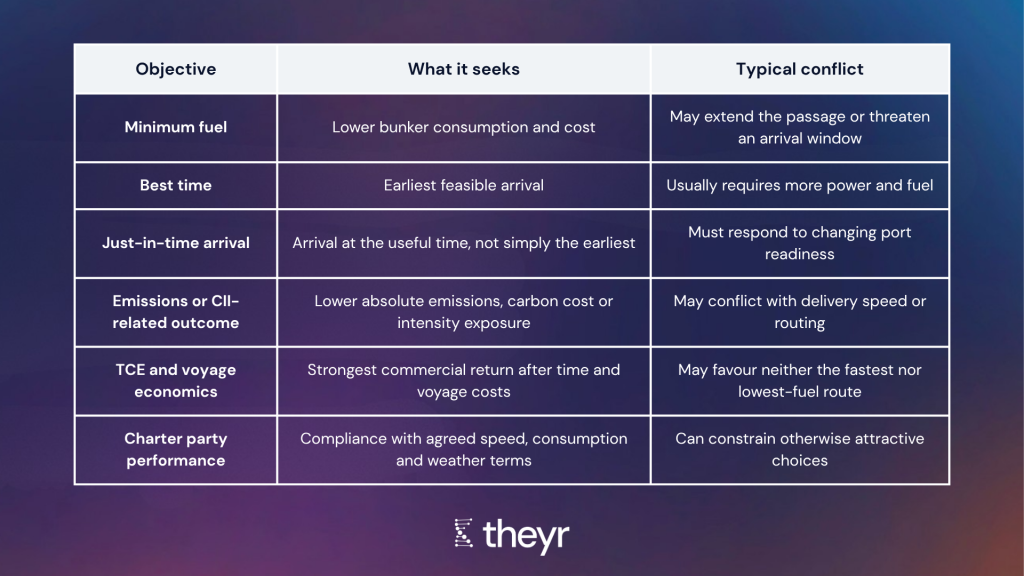
Balanced does not mean assigning equal weight to every objective. It means identifying the options that remain rational after the voyage’s priorities, economics and non-negotiable limits have been applied.
How multi-objective voyage optimisation works
1. Separate constraints from objectives
Fuel, voyage time, emissions and TCE can generally be treated as competing objectives. Land avoidance, restricted areas, draught, mandatory waypoints and defined safety limits should be treated as hard constraints. A credible system must never trade away safety simply because doing so improves fuel performance.
Commercial terms require more judgement. A cancelling date may be absolute; a preferred ETA may instead carry a cost for early or late arrival. A speed and consumption warranty may be represented as a compliance threshold, projected financial exposure, or both.
2. Optimise route and speed together
Route and speed are co-dependent. Speed determines when the vessel encounters a weather system; a route alteration changes current, wave encounter and power demand; and a just-in-time objective may favour a different speed profile as port readiness changes.
Meaningful optimisation must therefore evaluate route, speed, power or RPM as one problem, rather than optimising the track first and bolt on a speed recommendation afterwards.
3. Evaluate every candidate consistently
Every candidate voyage should be assessed using the same metocean forecast, navigational data, vessel specific hydrodynamic or performance model, departure and arrival assumptions, safety limits and commercial inputs.
The output is not simply a line on a chart. It is a projected performance package covering fuel consumption, duration, ETA, emissions, safety and commercial outcome.
4. Build the Pareto front
A voyage option is dominated when another option performs at least as well against every objective and better against at least one. Dominated options can be discarded.
The remaining non-dominated alternatives form the Pareto front. No route on this front is universally superior: improving one objective would worsen another. One route may minimise fuel, another may protect the earliest arrival, while a third may produce the strongest TCE or charter party position. The Pareto front therefore converts optimisation from a single recommendation into a transparent decision set.
5. Apply the voyage’s priorities
A vessel facing a firm delivery window may prioritise ETA reliability. A shipowner carrying bunker risk may favour lower consumption and reduced penalty exposure. A charterer may value earlier cargo availability. A fleet operator may choose to protect a CII-related target, provided the impact on voyage economics remains acceptable.
The algorithm does not replace commercial judgement. It gives that judgement stronger options, quantified consequences and an auditable basis for the final choice.
6. Re-optimise when conditions change
The Pareto front is dynamic. A revised forecast, changing port readiness, actual fuel consumption, an engine limitation or a charterer’s instruction may alter the relative value of every option.
In operational terms, real-time optimisation means recalculating whenever material inputs change. The route selected at departure should not remain unquestioned simply because it was optimal three days earlier.
Commercial constraints belong inside the optimisation
Speed and consumption warranties, ballast and laden assumptions, good-weather definitions, laycan, bunker prices, hire, bonuses, penalties and carbon-related costs all influence what ‘optimal’ means. The route with the lowest operating cost may create a larger contractual loss; a modest increase in fuel may protect ETA or avoid significantly greater commercial exposure.
A contract-aware workflow should translate relevant terms into structured inputs, calculate their effect for every candidate route, and update the projected end-of-voyage position as actual performance develops. It should also preserve both owner and charterer perspectives, because their economic interests may not be aligned.
Within T.VOS, the Dynamic Charter Party approach evaluates charter terms, weather exclusions and financial clauses alongside fuel, emissions and voyage time during both planning and execution.
Software does not replace the legal or commercial interpretation of a charter party. Its role is to expose the operational and financial consequences early enough for the parties to act.
Data quality determines decision quality
Four data layers are fundamental:
- Metocean data: wind, waves, swell and currents across the voyage.
- Vessel performance data: a vessel-specific model covering relevant drafts, speeds, powers and operating conditions.
- Voyage and safety data: ENC verified optimised routes, ports, waypoints, exclusion zones, operating limits and arrival requirements.
- Commercial data: bunker prices, charter terms, TCE assumptions, carbon exposure and bunkering options.
The system should also compare predicted performance with reported performance during transit. If the vessel consumes more than expected, or the forecast materially changes, the model and decision should update rather than preserve false precision.
How T.VOS supports multi-objective voyage decisions
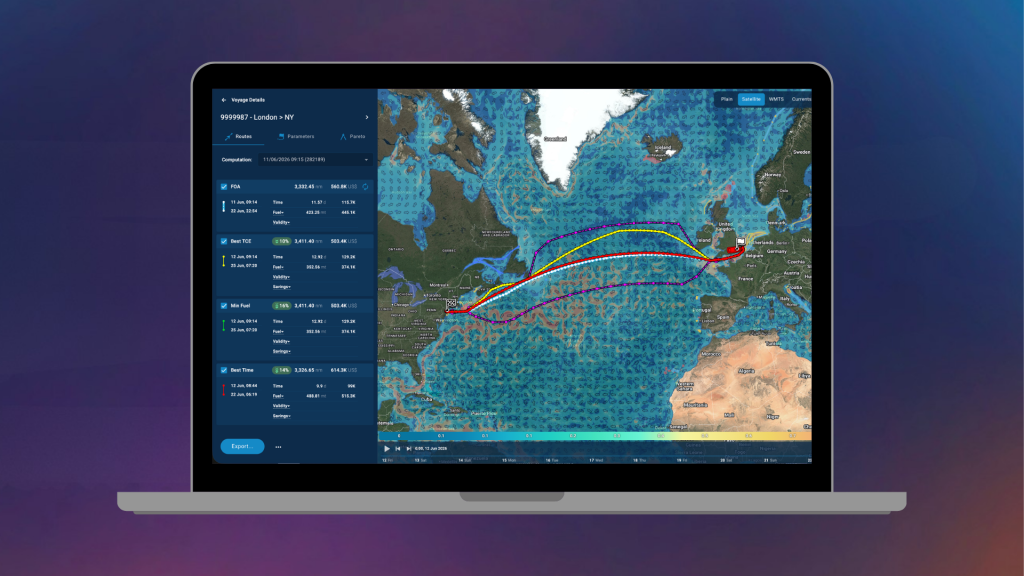
T.VOS is the first and only voyage optimisation solution designed to evaluate route, speed and timing across multiple objectives. It combines metocean and navigational data, vessel hydrodynamic models, safety parameters and commercial inputs. Outputs can include minimum-fuel, best-time, just-in-time, TCE, charter party and CII-related routes, together with Pareto-front alternatives that can be embedded in existing workflows.
The Dynamic Charter Party Module extends this capability by converting relevant contractual terms into computational logic. It evaluates speed and consumption warranties, weather exclusions and financial clauses alongside fuel, emissions and voyage time, shifting charter party compliance from post-voyage analysis to active, real-time decision support throughout the voyage.
For maritime technology providers, the API architecture allows these optimisation outputs to sit inside established fleet and voyage-management workflows. The value is not simply another route recommendation. It is a transparent view of which voyage plan best serves the operational and commercial objective now, and how that answer changes as the voyage evolves.
Frequently Asked Questions (FAQs)
What is the difference between single-objective and multi-objective voyage optimisation
Single-objective voyage optimisation selects a route against one principal target, such as minimum fuel or shortest time. Multi-objective optimisation evaluates several targets independently and presents the strongest trade-offs between them, subject to defined operational and safety constraints.
Can voyage optimisation balance fuel savings with an ETA requirement?
Yes. T.VOS can compare route and speed profiles that minimise fuel while meeting a defined ETA or contractual arrival window. If the absolute minimum-fuel route misses that requirement, it can quantify the additional fuel or alternative routing needed to protect the arrival objective.
Can charter party terms be included in multi-objective voyage optimisation?
Yes, provided the relevant terms are translated into structured logic. Speed and consumption warranties, weather exclusions, arrival requirements and financial consequences can then be assessed consistently for every candidate voyage.