
Questions
A voyage optimisation system can examine hundreds of thousands of possible routes, account for changing weather and ocean conditions, model a vessel’s fuel consumption and balance several commercial priorities at once. But for the person making a decision, the result still needs to arrive within minutes. And it needs to make sense.
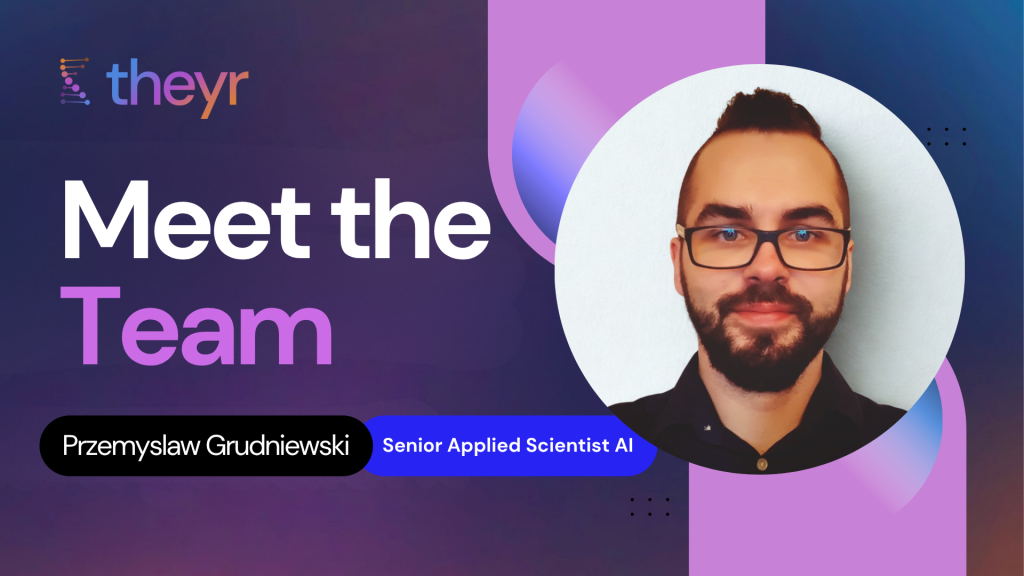
That balance between scientific depth and operational usefulness sits at the centre of Przemyslaw Grudniewski’s role at Theyr.
As Senior Applied Scientist AI, Przemyslaw works on the optimisation engine at the heart of T.VOS, the vessel digital twins that support fuel calculations and the new functionality built around them. His role also brings him into direct contact with customers, helping them understand how the system behaves and how different parameters influence the voyage options it produces.
With a background spanning engineering, artificial intelligence and academic research, Przemyslaw has been involved in T.VOS throughout its development, from early research and proof-of-concept work to a fully operational product.
We spoke to him about the science behind T.VOS, the challenge of making advanced optimisation work at operational speed and what agility means when every customer has a different definition of the optimal voyage.
How would you describe your role as Senior Applied Scientist AI at Theyr and where do you see your work having the biggest impact on T.VOS and its users?
At the centre of my role is the development and continuous improvement of the AI optimisation engine that powers T.VOS. I am also responsible for integrating the vessel digital twins used for fuel calculations into our systems, as well as implementing new T.VOS functionality that may affect, or be affected by, the optimisation engine and its underlying logic.
That means I am directly responsible for much of the solution’s effectiveness and behaviour. We have developed a novel multi-objective voyage optimisation system, but the work does not stop once the product is operational. It is a process of constant improvement. We need to remain ahead of the market, adapt as requirements change and continue responding to our customers’ needs.
My role is not limited to research and development. I am also personally involved with customers, listening to and evaluating their requirements and suggestions. Part of that work is determining which proposed features are technically feasible, which align with our product plan, and how they should be prioritised within the roadmap. I support customers throughout the integration process and during day-to-day operations. This includes answering questions about T.VOS, explaining how the optimisation process works, and giving them greater insight into the system’s decision-making logic.
Customers may want to understand why a vessel was routed one way rather than another, or how the available voyage options were affected by a particular combination of configuration parameters. It is a very hands-on process, but an important one. It helps customers make better use of T.VOS, obtain more value from the system and build confidence in the optimised voyages it provides.
You have been involved in the research, development and management of T.VOS since joining Theyr. What has been one of the most interesting scientific or technical challenges in that work?
I have been involved in T.VOS throughout all stages of its development, from TRL 1 and the early research into multi-objective optimisation methodology, through proof-of-concept work and validation, to TRL 9 and a fully operational solution. There have been many interesting challenges along the way.
For me, one of the most significant, both scientifically and technically, concerned computational efficiency and calculation time. I was moving from academia into an applied technology environment when I joined Theyr. What counts as an acceptable calculation time in scientific research can be very different from what is practical for a customer using the system in real operations.
In research, the priority is often knowledge, understanding, effectiveness and accuracy. Calculation time may be a secondary concern. When working with vessels, however, whether for initial voyage planning or for a ship already under way, waiting more than 30 minutes for an optimised voyage is neither feasible nor useful. The operational cost of running a system in that way would also be too high.
Addressing this was a substantial challenge because T.VOS works with high-resolution data and a high density of calculations. It incorporates vessel digital twins and multiple operational constraints to maximise accuracy. Its multi-objective optimisation engine is also considerably more computationally demanding than simpler alternatives. While those approaches may be faster to run, they are also significantly less effective, reflecting the standard trade-off between computational efficiency and optimisation performance. T.VOS evaluates approximately 400,000 route options during a single optimisation.
The initial proof of concept took around 25 minutes to optimise one voyage. The current version can complete the same task in less than few minutes. That reduction represents a significant achievement by our development team. It has allowed us to retain the depth and accuracy of the optimisation while making the system practical for real operational use. We are continuing to improve its efficiency.
From a science and product-development perspective, what does agility look like inside Theyr and why does it matter when building technology for maritime operations?
At Theyr, agility is the ability to translate scientific advances, operational data and customer feedback into product improvements that deliver measurable value in real-world operations. It is not simply a matter of developing software faster. It is about learning continuously, validating our work and adapting the technology as operational requirements, regulations and user needs evolve.
Maritime operations are shaped by a complex and dynamic set of variables. Every voyage is affected by weather, ocean currents, vessel speed and performance, fuel prices, emissions regulations and commercial priorities. Our commercial partners also have different expectations of how T.VOS should balance those factors. One customer’s definition of the optimal voyage may be very different from another’s. To accommodate those requirements, we have continually expanded T.VOS with configurable options and customisation capabilities.
Agility does not mean accepting every proposed change, however. Each suggestion needs to be assessed and validated carefully. In some cases, we have to decline requests because they are either technically infeasible or do not align with our long-term product roadmap. Moving quickly still requires judgement and scientific discipline.
A recent example is the explainable AI, or XAIM, module that we are developing. We often receive enquiries from commercial partners who want to understand why T.VOS selected a particular route or speed profile. Without a clear explanation of the optimisation process and its decision-making logic, a recommendation may initially appear unintuitive and can therefore be more difficult to trust.
Providing that explanation currently requires a detailed and time-consuming semi-manual investigation. To address this, we are collaborating with the Alan Turing Institute on a reporting module designed to generate real-time, human-readable explanations of T.VOS’s routing decisions automatically and answer potential questions. The objective is to give users greater transparency into the optimisation process and strengthen their confidence in the recommendations they receive.
Outside work, what keeps you curious and learning?
I am someone who enjoys learning new things outside work as well. When something catches my attention, I will usually spend time reading about it or watching videos and podcasts until I understand it better. A lot of that curiosity is still connected to technology, computers and, of course, AI, both professionally and outside my day-to-day work.
We are living through a particularly interesting period of technological change. Something can appear novel and fresh one day, then be substantially improved or even made obsolete within six months. We have moved from looking at rather strange AI-generated images on computer screens to seeing videos that can be almost indistinguishable from reality, alongside trials of brain-computer interfaces. With that pace of change, it is difficult not to be curious.
Away from technology, I enjoy staying active, reading fiction, and assembling and painting miniatures. Having that balance helps me recharge and return to work with a fresh perspective.
Przemyslaw’s work sits at the intersection of an optimisation method that performs well in research and a system that people can rely on during a live voyage. The difference is measured not only in accuracy, but in calculation time, transparency and the ability to respond to different operational priorities. At Theyr, applied science remains close to both the product and the people using it, helping turn sophisticated optimisation into practical, trusted decision support at sea.