
Table of Contents
The highest commodity price does not necessarily represent the best commercial opportunity. A cargo may command a premium in one market, yet require a longer voyage, higher transport costs, greater exposure to delay or tighter infrastructure constraints. A lower-priced destination can ultimately deliver the stronger commercial outcome.
That distinction sits at the heart of commodity decision-making. Market intelligence can identify where opportunities exist. The harder question is what to do with that intelligence: which combination of cargo, supplier, destination, route and timing creates the most attractive outcome once return, risk and operational reality are considered together?
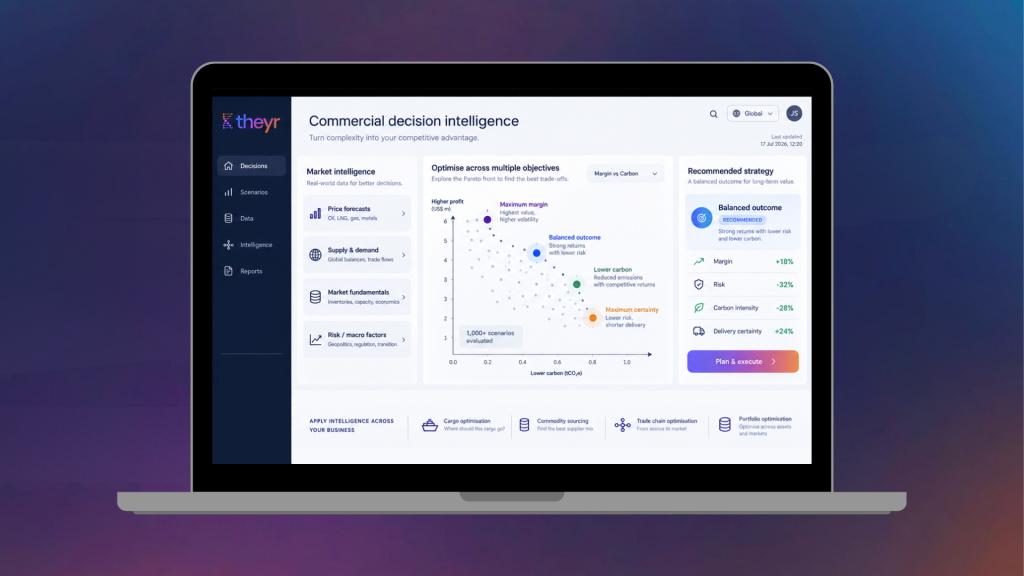
Multi-objective optimisation provides the bridge between understanding the market and deciding how to act. Rather than reducing a complex commercial decision to a single metric, it evaluates competing objectives and constraints simultaneously and makes the trade-offs visible.
Intelligence explains the market. Optimisation turns it into action.
Commodity intelligence brings together price forecasts, supply-and-demand balances, trade flows, inventories and market fundamentals. It is strengthened by information on production capacity, ports, terminals, pipelines, storage, regulation and geopolitical developments. Together, these datasets create a sophisticated view of what may be commercially attractive and operationally possible.
But insight is not the same as a decision. A forecast can identify a promising destination without establishing whether it remains attractive once freight, vessel availability, terminal capacity, delivery windows, contractual obligations and risk are included.
The next step is therefore prescriptive: not simply predicting what may happen, but evaluating what the business should do under different priorities and constraints. This is where multi-objective optimisation can add a decision layer above market intelligence.
Optimising the whole commercial decision
Traditional optimisation often starts with one definition of success: maximise margin, minimise cost or reduce transit time. Commodity trading rarely works that way. Improving one outcome can weaken another, and some choices that appear attractive commercially may not be operationally feasible.
A multi-objective engine can evaluate expected margin, risk, time, carbon, reliability and optionality together. At the same time, capacity, contractual commitments, regulations, vessel characteristics and infrastructure availability can be treated as constraints that define what is actually executable.
The distinction is important. A trader may willingly sacrifice some expected margin for greater delivery certainty or flexibility. The same trader cannot select a strategy that depends on terminal capacity that does not exist.
As suppliers, cargoes, destinations, routes, vessels and delivery dates are combined, the number of possible strategies expands rapidly. Optimisation allows a much broader decision space to be explored than a small number of manually selected scenarios, exposing viable commercial alternatives that may otherwise remain hidden.
Theyr already applies this principle in voyage optimisation, where fuel consumption, voyage duration, arrival timing, weather risk and commercial performance must be balanced simultaneously. Our Dynamic Charter Party Module extends that calculation to contractual terms, allowing their likely financial consequences to be considered alongside operational outcomes before a voyage is committed.
“Best” is not one answer. Making the trade-offs visible
The output of multi-objective optimisation is not a single prescribed strategy. It is a set of Pareto-optimal alternatives: options for which one objective cannot be improved without compromising another.
For a commodity transaction, one strategy might maximise expected margin while accepting greater price or execution risk. Another may preserve most of that return while improving delivery certainty. A third may reduce emissions or shorten the delivery cycle, while another preserves more optionality if market conditions change.
This changes the commercial conversation from “Which option is best?” to “Best for what?” Decision-makers can see the price of each trade-off: how much margin is exchanged for lower risk, what faster delivery costs, or how much flexibility remains after a commitment is made.
That transparency also creates a common decision framework across trading, procurement, logistics and operations. Teams can work from the same assumptions and alternatives while applying their own priorities, making the commercial consequences of each choice explicit before capital or capacity is committed.
From a single cargo to the wider portfolio
The same optimisation framework can operate at several levels across commodity markets.
Cargo and destination optimisation can compare alternative markets for LNG, crude, refined products, coal, metals or other commodities using expected netback, transport requirements, timing, risk and operational feasibility rather than headline selling price alone.
Sourcing optimisation can assess supplier combinations against purchase cost, quality, reliability, logistics, carbon performance and delivery requirements. A supplier with the lowest quoted price may cease to be the most attractive option once the complete delivered outcome is considered.
Trade-chain optimisation can connect production, transport, storage and final-market decisions. This makes it possible to understand how a choice at one stage affects value, capacity and risk elsewhere in the chain.
Portfolio optimisation takes the concept further by evaluating multiple cargoes, vessels, markets and commitments together. When assets and infrastructure are shared, the strongest individual trade may not produce the strongest portfolio outcome. Optimisation can instead identify combinations that use scarce capacity more effectively across the business.
A decision layer above commodity intelligence
The opportunity is not to replace forecasts, analytics or commercial judgement. It is to make them actionable. Market intelligence provides the inputs; optimisation systematically explores the available choices; commercial teams retain control over which balance of return, risk, timing, carbon and flexibility they prefer.
The process can also remain dynamic. As prices move, forecasts change, infrastructure becomes unavailable or delivery expectations shift, the decision can be re-optimised using the latest information. The business is no longer tied to the assumptions that supported an earlier plan.
This makes data quality and transparency critical. Forecasts, operational information and contractual parameters must be credible, and users need to understand why alternatives have been presented. The value of decision intelligence lies not simply in calculating an answer, but in making the assumptions, constraints and trade-offs behind the answer clear.
From market insight to commercial decision intelligence
For technology and data providers, this creates an opportunity to move beyond descriptive and predictive intelligence towards a prescriptive layer. Rich commodity datasets and forecasting models can be combined with a scalable optimisation engine to evaluate what actions are available and how those actions perform against competing commercial objectives.