
Table of Contents
A charter party speed and consumption clause sets the vessel’s contractual performance benchmark: the speed the vessel is expected to achieve, the fuel she may consume and the conditions in which that performance will be assessed. For operators, the job is not simply to compare average speed with average daily consumption. It is to keep the clause’s underlying assumptions aligned with the voyage: loading condition, draft, fuel grade, speed orders, route, weather, swell, currents, exclusions and evidence.
When one of those inputs is missing or incorrectly applied, a manageable variance can become a speed deficiency or overconsumption claim after arrival. The better approach is to monitor the contractual position while there is still time to influence it.
Speed and performance provisions commonly combine a specified speed, a set fuel-consumption rate and defined operating conditions, but their effect depends on the precise words agreed.
How a charter party speed and consumption clause works
In a typical time charter, the vessel is described as capable of maintaining an agreed speed while consuming an agreed quantity and grade of fuel under specified conditions. Separate figures may apply when the vessel is ballast or laden, at different speeds, or when operating in an eco or slow-steaming mode.
Effective monitoring starts with the Charter Party clause, not with the noon report
A noon report tells the desk what the vessel reported during a particular period. It does not, by itself, tell the desk whether the vessel complied with the charter party.
Before departure, the commercial wording must be translated into operational fields. At minimum, operators need to capture:
The applicable vessel condition. Ballast and laden warranties should remain separate. Draft, trim, displacement and cargo condition can materially alter the power required to maintain speed. A generic vessel curve or a figure copied from a previous voyage is not a substitute for the contracted condition.
The speed basis. Record the instructed speed, actual speed, RPM or power setting and the measurement basis used by the performance calculation. Where available, retaining both speed over ground and speed through water makes the effect of current easier to investigate, even if the clause ultimately gives one measure contractual priority.
The fuel basis. Separate fuel by grade and by consumer where the records allow it. Main-engine consumption should not be mixed indiscriminately with auxiliary-engine or boiler consumption if the clause treats them differently. The start and end of the assessment period must also be consistent.
The warranty duration. Some wording creates a continuing performance obligation throughout the charter, while other vessel descriptions may apply only at the time of delivery, unless the Charter Party states otherwise. Owners’ maintenance obligations may also remain relevant. Operators should therefore avoid assuming that every speed and consumption description creates the same ongoing obligation and should always refer to the specific wording of the Charter Party.
The order of precedence. The recap, printed form, vessel description, appendices, rider clauses and any subsequent amendments must be brought together into one clear contractual baseline. The correct hierarchy of documents and any amendments need to be understood before performance is assessed. A technically accurate calculation against the wrong contractual terms is still the wrong calculation.
Weather allowances are filters, not blanket credits
One of the most common operational mistakes is to confuse a planning sea margin with a contractual weather allowance.
A sea margin may be used internally to make a voyage estimate more realistic. A good-weather definition serves a different purpose: it determines which periods qualify for assessing the vessel against the warranty.
Good-weather wording commonly addresses some or all of the following:
- maximum wind force and, sometimes, wind direction;
- maximum sea state or significant wave height;
- separate limits for swell;
- adverse, favourable or negligible currents;
- the required duration of a qualifying period;
- deep-water or unrestricted-water conditions; and
- the source of weather evidence.
Beaufort Force 4 and Douglas Sea State 3 frequently appear in performance provisions, but they are not a universal definition that overrides the contract. Steamship Mutual notes that clauses may also address swell, specified sea states and currents. A West P&I case report shows why the drafting detail matters: where the charter party stated a specific maximum wave height, the tribunal applied that express figure rather than a wider interpretation of the sea-state label.
Wind is only one part of the test
A noon period should not be classified as good weather merely because the reported wind is within the agreed Beaufort limit. Combined sea and swell may exceed the clause. A moderate wind against a significant head swell may affect the ship differently from the same wind in following seas.
The operator should therefore retain time- and position-matched values for:
- wind speed and direction;
- wave height, direction and period;
- swell height, direction and period; and
- surface current speed and direction.
This is where high-fidelity metocean data becomes commercially important. It is not enough to know that a weather system existed somewhere in the region. The analysis needs to show what conditions affected the vessel along the track and during the relevant period.
Current treatment must be explicit
Wording such as “no adverse currents” may remove periods of adverse current from the good-weather sample. It does not automatically settle whether favourable currents should be deducted from the achieved speed. Published decisions and industry guidance do not provide a single, universally applied current-adjustment method. The contract should state the intended treatment, and the performance model should preserve both the raw data and any correction applied.
A representative sample is not always a full day
Some clauses require 24 consecutive hours of qualifying weather. Where the contract is silent, the issue is whether there is a sufficiently representative sample, which depends on the voyage and evidence. There is no fixed judicial rule that automatically makes one duration sufficient in every case.
The distinction matters because a voyage may contain only short windows that satisfy every wind, wave, swell and current threshold. Operators should flag that limitation rather than forcing an assessment from a weak sample.
Good-weather analysis may affect the wider voyage
Under a commonly used assessment approach, performance is measured during qualifying good-weather periods and any established shortfall is then applied more widely, subject to the charter wording and relevant exclusions. Clauses can alter or restrict that approach, so the calculation method must be settled before the result is treated as contractual fact.
Consumption Variance: Diagnose the Cause Before Quantifying the Claim
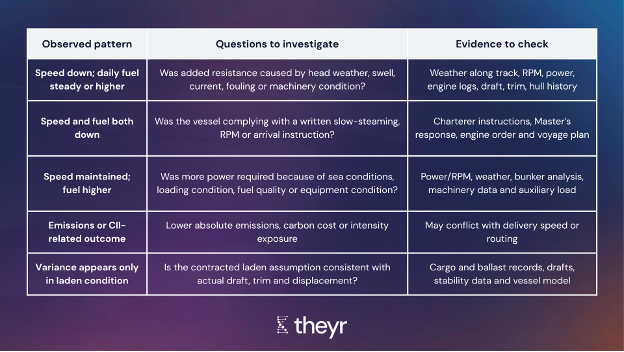
Excess consumption is a symptom, not proof of contractual underperformance.
Fuel consumption can vary for many reasons, including speed orders, adverse weather, currents, loading condition, trim, hull or propeller fouling, machinery condition, fuel characteristics, auxiliary demand, routing decisions and measurement error.
The first operational task is therefore not to calculate the value of a potential claim, but to identify and separate the causes of the variance. Only then can the operator determine whether the excess consumption is attributable to vessel performance, external conditions or operational decisions and whether it is relevant under the Charter Party.
1. ETA drift rarely looks material at first. Small slippage can create significant commercial exposure.
An ETA is the output of multiple moving variables. Route, speed profile, weather, currents, vessel performance and operational instructions all influence it. Treating ETA as a fixed number from the initial passage plan allows small deviations to compound and commercial exposure to build unnoticed.
A vessel may initially appear safely inside its arrival window. A head current then persists longer than forecast. The vessel slows to avoid heavier weather. A charterer requests a different arrival profile. None of these events necessarily creates a claim by itself. The commercial risk emerges when their cumulative impact is not recalculated, understood and communicated.
ETA drift can affect:
- laycan or cancelling-date discussions;
- berth and cargo planning;
- contractual ETA notices;
- just-in-time arrival instructions;
- speed-up or slow-steaming decisions;
- delivery expectations and downstream commitments.
The commercial question is not simply, “What is the vessel’s ETA now?” It is, “Where is the voyage likely to finish under the current route and operating profile, what commercial exposure does that create, and what alternatives remain available?”
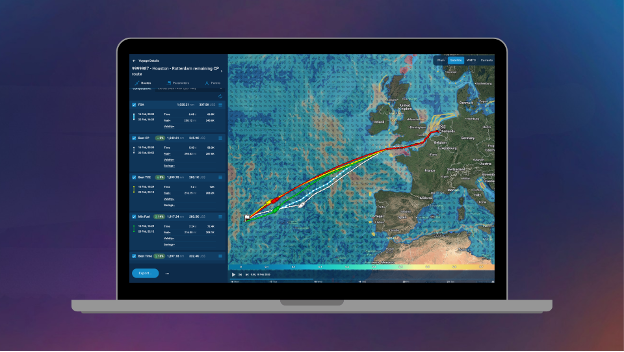
T.VOS addresses that question through dynamic route and speed calculations and a projected end-of-sea-passage view. The Dynamic Charter Party Module combines past and actual performance, current conditions and the forecast for the remaining route, then updates the expected outcome against the agreed charter terms.
Contractual process still matters. BIMCO’s Just in Time Arrival Clause allows charterers to request a speed adjustment to meet a specified arrival time, but the request, owners’ agreement, vessel capability and any effect on the cancelling date must be managed in accordance with the clause. Better ETA intelligence therefore needs to be connected to written instructions and a clear approval process.
A more accurate ETA does not reduce exposure if it stays on an operator’s screen. It reduces exposure when it triggers the right commercial decision and the right communication.
2. Speed and consumption assumptions: when planning numbers become performance disputes
Speed and consumption claims often begin before departure, when a complex performance clause is reduced to one convenient number.
A charter party may distinguish between ballast and laden conditions, specified drafts, fuel types, good-weather limits, engine modes and agreed speeds. Operationally, however, these are often reduced to a generic service speed and standard consumption curve. The risk is that the voyage is then managed against one benchmark while any subsequent performance claim is assessed against another.
Recent guidance makes the legal and evidential sensitivity clear: speed and performance disputes can depend heavily on the precise wording of the good-weather definition and the evidence available on weather conditions. The same guidance cautions that there is no universal “about” allowance that can safely be applied without considering the vessel and the charter wording.
A clause-aware optimisation process should therefore model:
- contracted speed and consumption rather than an internal estimate;
- ballast and laden performance separately;
- the vessel’s actual hydrodynamic characteristics;
- relevant weather and current criteria;
- any agreed tolerances;
- the effect of speed instructions on fuel and ETA;
- the projected position at the end of the passage.
The Dynamic Charter Party algorithm supplied by Theyr is designed to turn guaranteed speed, fuel consumption, weather exclusions and financial clauses into inputs for T.VOS’s optimisation engine. As route and speed options are assessed, the system can calculate their likely charter party implications alongside fuel, time and emissions.
Consider a vessel beginning to fall behind its assumed speed while remaining close to its fuel target. A fuel-only system may still judge the voyage satisfactory. A contract-aware system should recognise the trade-off: fuel performance may remain on target while the speed buffer erodes, increasing potential exposure against ETA or performance obligations.
The operator can then compare the actual choices:
- increase speed and accept higher consumption;
- change route to recover time;
- preserve the present route and revise the ETA;
- obtain or confirm a charterer instruction;
- accept a projected variance but document it properly.
Optimisation does not decide which party is legally responsible. It gives the desk time to choose a commercially deliberate response rather than discover the issue in a post-voyage performance report.
3. Weather deviation: good seamanship can still produce a poor claim file
Weather routing and charter party weather assessment are related, but they are not the same task.
A Master may alter course for entirely sound navigational or safety reasons. The subsequent dispute may concern whether the deviation was permitted, whether the weather was within the contractual definition, how much delay or additional consumption it caused, and whether the counterparty was informed properly.
A weak record often contains the final route and the final weather report, but not the information that mattered when the decision was taken. A more defensible record should show:
- the forecast available at the time;
- the expected conditions on the original and amended routes;
- the route or speed alternatives considered;
- the actual conditions encountered;
- the Master’s or operator’s rationale;
- relevant orders and notices;
- the effect on ETA, speed and consumption.
This distinction matters because weather sources do not always agree. Vessel logbooks and weather-routing reports can identify different good-weather periods, creating disputes over which evidence should prevail. The charter party may specify the governing source but frequently does not.
T.VOS combines metocean information with ship hydrodynamic models and route calculations. The Dynamic Charter Party Module is designed to apply live and historical weather data to compliance assessment, quantify the effect of conditions on speed and fuel consumption, and distinguish relevant good-weather and bad-weather periods.
The benefit is consistency. The weather used to plan or re-optimise the voyage can also support the operational explanation of what changed and why. That reduces the gap between the routing decision and the later performance assessment.
It does not mean that software output determines contractual interpretation. Clause wording, vessel records, quality of evidence and governing law still shape the legal analysis. The value lies in creating a clear, contemporaneous record of what happened, why decisions were made and how performance evolved—rather than trying to reconstruct that picture after a dispute has arisen.
4. Late notices: accurate information has little value after the deadline
An operator can identify an ETA change correctly and still leave the business exposed if the information is not sent to the correct recipient, in the required form and within the contractual timescale.
Notice risk can arise around:
- revised ETAs;
- delay and deviation;
- charterer speed instructions;
- port or berth changes;
- bunkering deviations;
- cargo readiness;
- just-in-time arrival requests;
- arrival and Notice of Readiness procedures.
The operational and contractual workflows must remain connected. BIMCO’s Sea Traffic Management Clause emphasises the sharing of arrival information, but also states that voyage optimisation does not remove the separate requirement to tender Notice of Readiness in accordance with the charter party’s laytime provisions.
Written instructions also matter when speed is changed. BIMCO’s Slow Steaming Clause requires charterers’ slow-steaming instructions to be given to the Master in writing, creating a contemporaneous record of what was ordered if a dispute later arises. Crucially, those instructions remain subject to the Master’s overriding responsibility for the safety of the vessel, crew and cargo.
Voyage optimisation can improve this process by identifying the event that should trigger action. An ETA variance, projected fuel exceedance or developing speed shortfall can be flagged before the commercial consequence becomes fixed. An API-first solution can also feed that information into the platform or workflow already used by the operator.
5. Poor evidence capture: the claim that nobody can reconstruct cleanly
Post-voyage disputes become harder when the relevant evidence is scattered across noon reports, email chains, messaging applications, weather files, routing reports, voyage-management systems and port documents.
The problem is rarely a complete absence of data. It is the absence of a coherent sequence.
A useful claim file should answer five questions:
- What contractual baseline was the voyage being managed against?
- What did the route, ETA and performance projection show at each material decision point?
- What changed?
- Who instructed or approved the response?
- What was the eventual fuel, time and commercial outcome?
T.VOS-generated voyage datasets can include route, speed, ETA and ETD, power or RPM, fuel consumption and metocean parameters, with outputs available in formats including JSON, CSV and RTZ. The value of these fields is not simply that more data is retained. It is that the progression from initial plan to revised plan and final outcome can be shown consistently.
The voyage optimisation record should sit alongside, rather than replace:
- the executed charter party and recap;
- voyage and charterer instructions;
- vessel logs and noon reports;
- ETA and delay notices;
- Notices of Readiness;
- Statements of Facts;
- protest letters;
- agent and terminal communications;
- bunker and ROB records.
Why multi-objective voyage optimisation matters to claims prevention
The route with the lowest predicted fuel burn is not necessarily the route with the best commercial outcome.
A fuel-saving route may weaken ETA certainty. A faster route may increase consumption beyond a contracted allowance. Avoiding one weather system may extend distance and create a notice or delivery issue. Slow steaming may improve emissions performance while changing the basis on which speed warranties apply.
This is why charter party claims cannot be treated as a separate calculation added after the route has been selected.
T.VOS uses multi-objective optimisation to evaluate route and operating choices across objectives such as minimum fuel, best time, just-in-time arrival, TCE, CII and charter party performance. Rather than producing one supposedly perfect answer, it can produce a set of optimised alternatives showing where one objective improves and another requires a trade-off.
An owner may prefer a route that limits bunker consumption and preserves the vessel’s performance buffer. A charterer may place greater value on earlier cargo delivery, even where that requires higher fuel consumption. The Dynamic Charter Party Module is designed to present these perspectives alongside their likely commercial implications, giving both parties a more objective basis for evaluating the trade-off.
The aim is not to replace commercial judgement, but to make the available choices, trade-offs and likely consequences visible before an instruction is given, not after its impact becomes a dispute.
A practical claims-reduction workflow
Before departure: turn the charter party into operating controls
The first step is to translate the fixture into structured inputs. Speed and consumption warranties, ballast and laden conditions, weather criteria, ETA notices, laycan, deviation wording and relevant commercial clauses should not remain buried in PDFs and email chains.
Operators should then compare several voyage scenarios rather than approve one route in isolation. Each scenario should show its expected fuel, time, ETA, weather exposure and projected charter party result.
Before sailing, the team should also agree:
- who owns each notice and item of evidence;
- what amount of ETA drift requires escalation;
- what speed or fuel variance triggers review;
- when claims or commercial colleagues should become involved;
- which data source and document version form the operational baseline.
During transit: monitor where the voyage is heading
Daily monitoring should compare actual performance with the contracted basis, not only the internal voyage budget.
That means separating sea time from port time, retaining ballast and laden distinctions, classifying weather periods consistently and maintaining a projected end-of-voyage position. When a threshold is breached, the team should be able to compare revised routes and speed profiles while recovery is still possible.
The decision record should retain the projection before the change, the alternatives considered, the instruction given and the resulting forecast.
After the voyage: close the operational and evidential loop
The final reconciliation should compare the actual result with the most recent projected outcome. Material differences should be explained while the voyage is still fresh and supporting evidence remains accessible.
The completed record can then improve:
- future route and speed assumptions;
- vessel performance models;
- charter party negotiations;
- notice procedures;
- clause wording;
- operational escalation thresholds.
This is how claims prevention becomes cumulative. Each completed voyage produces a better basis for the next fixture rather than another isolated archive.
Where T.VOS fits
The Dynamic Charter Party Module, developed through the collaboration between Rensmarine and Theyr, brings charter party calculations into the T.VOS multi-objective voyage optimisation process.
Its role can be understood across three stages.
At planning, contractual speed, consumption, weather and financial terms are converted into computational inputs. Proposed routes can then be compared by fuel, time, ETA, emissions and likely charter party outcome.
During execution, actual speed, fuel and encountered conditions update the projected end-of-sea-passage position. Where the voyage is trending towards a speed claim, consumption penalty or missed commercial target, alternative route and operating choices can be assessed.
For commercial review, the platform provides a consistent operational history of the plan, changes and projected outcomes. Structured templates can be retained and reused, while the API-first architecture allows T.VOS capabilities to sit inside existing maritime platforms and workflows.