
Table of Contents
The shortest route is not always the lowest-emission route.
A vessel sailing into head seas may burn more fuel over fewer miles than one following a slightly longer track through more favourable conditions. If it then arrives early and spends two days at anchor, the supposedly efficient voyage becomes wasteful by the time it closes.
Voyage optimisation reduces emissions by identifying the combination of route, speed, power or RPM and arrival timing that minimises fuel consumption while respecting safety, ETA, port and commercial constraints. Crucially, the calculation must remain dynamic, adapting as forecasts, vessel performance and arrival requirements change.
This operational contribution matters. The IMO’s 2023 GHG Strategy calls for total greenhouse gas emissions from international shipping to fall by at least 20%, striving for 30%, by 2030 compared with 2008. It also targets a reduction in shipping’s carbon intensity of at least 40% over the same period.
How voyage optimisation can reduce emissions
For vessels using conventional marine fuels, the immediate relationship is simple: burn less fuel and operational, or tank-to-wake, CO₂ emissions generally reduce.
Achieving that saving is less simple. Fuel consumption reflects the interaction between distance, wind, waves, currents, loading condition, hull behaviour, engine setting, arrival time and port delays. Optimising any one variable in isolation may merely shift consumption elsewhere.
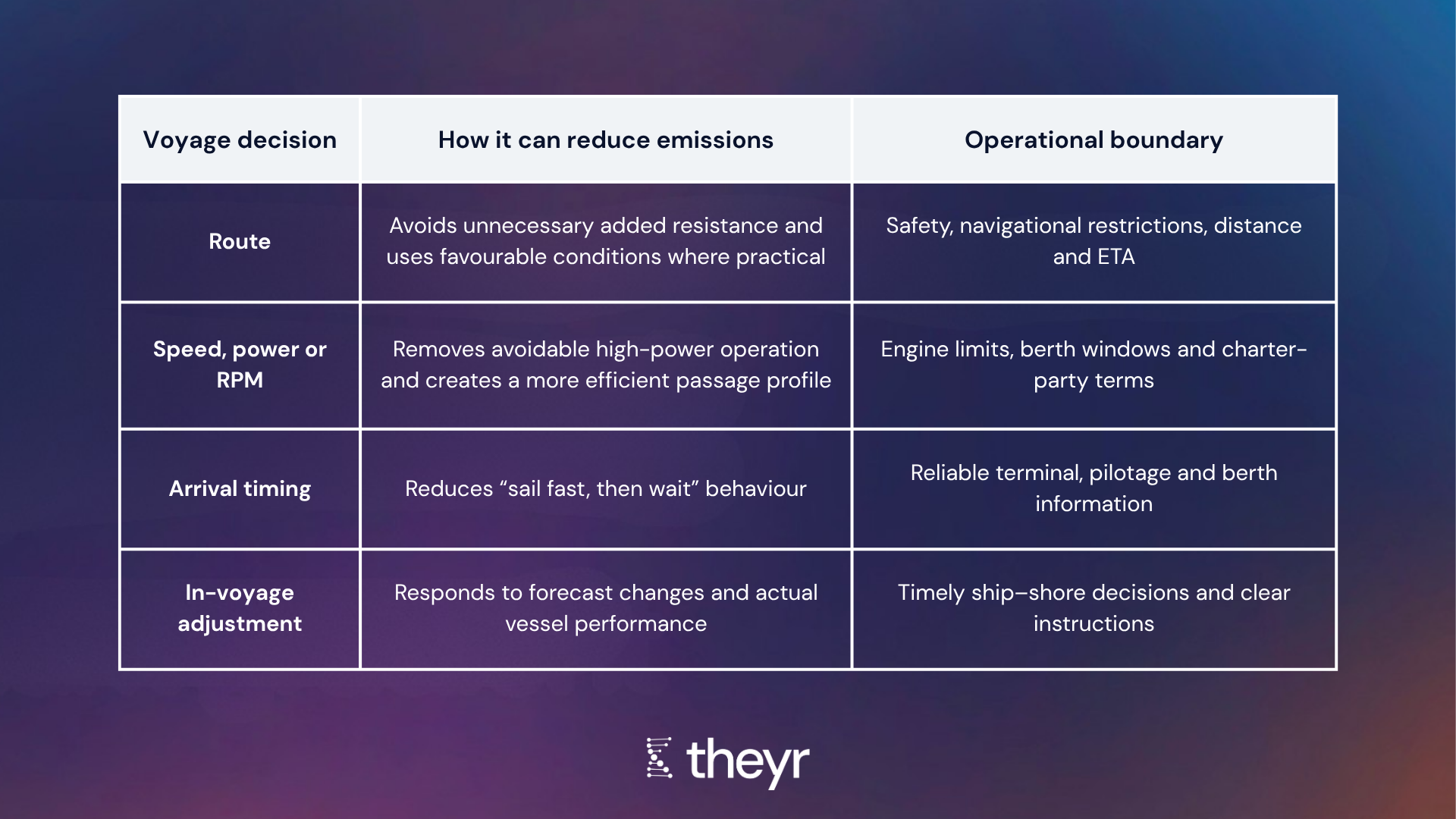
The right question is not simply, “Which route is shortest?” It is:
“Which executable voyage uses the least energy while delivering the required safety, operational and commercial outcome?”
Route for energy demand, not distance alone
Weather routing is an essential part of voyage optimisation, but it is only one part of the calculation.
Wind and waves create added resistance. Currents alter speed over ground for a given power setting. A shorter route through persistent head seas can therefore require more fuel than a slightly longer route through less demanding conditions.
The answer also changes from vessel to vessel. A laden tanker, a ballast bulker and a container ship will respond differently to the same wind and wave field. Draft, displacement, hull form, propulsive characteristics and operating limits all influence the energy required for each route segment.
Credible voyage optimisation therefore requires both high-fidelity metocean data and a vessel-specific performance model.
The forecast describes the environment the vessel is likely to encounter. The performance model estimates how that particular vessel will respond. Without both, the result risks becoming little more than a weather overlay attached to a generic speed-consumption curve.
The lowest-emission route may indeed be the shortest. The point is that this should be demonstrated by calculation, not accepted as an assumption.
Optimise speed across the passage
Speed management is often reduced to a single instruction: slow down.
That is too crude for a real voyage. The lowest-emission plan is usually a dynamic speed profile, not one speed maintained from departure to arrival.
A vessel may benefit from easing down early after a berth window changes. It may need to maintain power through a short period of adverse weather before reducing RPM in better conditions. On another voyage, protecting a berth slot may justify a higher speed for part of the passage because missing it would create additional sailing, waiting or downstream disruption.
The IMO’s GreenVoyage2050 speed-management guidance gives an indicative total fuel-saving range of 3–12%. It also stresses that the result depends on the vessel’s original speed and the speed to which it is reduced. The range illustrates the opportunity, but it should not be presented as a guaranteed saving for every vessel or route.
Very low speed is not automatically optimal. A longer passage can increase auxiliary consumption, reduce schedule resilience and create the need for a later speed-up when weather or port plans change.
Effective speed optimisation answers a more precise question:
Which route and speed profile will achieve the required arrival time with the lowest total fuel consumption, within the vessel’s technical and commercial limits?
Replace “sail fast, then wait” with just-in-time arrival
A vessel that races to port only to wait at anchor has converted arrival uncertainty into unnecessary fuel burn.
Just-in-time arrival tackles that inefficiency by giving the vessel a reliable required time of arrival and using the available passage time intelligently. Instead of maintaining service speed against an outdated ETA, the vessel can adjust earlier and absorb expected waiting time at sea, where speed can be managed efficiently.
An IMO-commissioned study of container shipping estimated that just-in-time arrival could reduce fuel consumption and resulting CO₂ emissions by 14% per voyage when optimisation was applied across the full passage. The result is specific to the study’s container-shipping scenarios rather than a universal fleet benchmark. Its most useful finding is the importance of timing: the earlier the vessel receives reliable arrival information, the greater the opportunity to manage speed efficiently.
This makes the port call an integral part of voyage optimisation.
Berth availability, terminal readiness, pilotage, fairway access and cargo information must reach the vessel early enough to influence the remaining voyage. A late update may prevent some waiting, but it leaves far less passage over which fuel can be saved.
Just-in-time arrival is not slow steaming under another name. It depends on a credible arrival target, dependable ship-shore communication and the ability to recalculate the route and speed plan around changing conditions.
Re-optimise when the assumptions change
A route calculated at departure reflects a particular forecast, vessel condition and arrival requirement. None of those assumptions is guaranteed to remain valid.
Weather forecasts change. A vessel may perform above or below its modelled condition. Port readiness changes. A cargo programme may move forward or backwards. Commercial teams may receive new instructions.
Dynamic voyage optimisation compares actual progress with the plan and reassesses the remaining options. It may confirm the existing route, recommend a modest course adjustment or revise the speed, power or RPM profile.
The objective is not constant course-changing. It is to avoid following yesterday’s optimum after the assumptions behind it have expired.
Execution is decisive. Recommendations must reach the bridge in a practical form, shore teams need to understand why they changed, and the master’s authority over safe navigation must remain absolute. Even the best calculation delivers no emissions benefit if it arrives too late or cannot be translated into an executable instruction.
Why minimum fuel is not enough
Consider three feasible plans for the same voyage:
Plan A predicts the lowest fuel consumption but misses the working berth window. Plan B protects the earliest ETA but requires sustained high power and is likely to end at anchor. Plan C uses slightly more fuel than the theoretical minimum, arrives just in time, stays within the charter-party performance envelope and avoids waiting.
A single-objective system may choose Plan A or Plan B, depending on the target it was given.
A multi-objective system makes the trade-offs visible instead of burying them inside one score. These alternatives can be represented on a Pareto front: each option is efficient because no objective can be improved without worsening at least one other. Fuel, time, ETA, TCE, CII, safety and contractual performance can therefore be evaluated together.
This matters because a theoretical minimum-fuel route is commercially useless if it cannot be executed. Missing an arrival window may require recovery speed later; breaching charter-party terms may create a claim; and reducing fuel at the expense of transport work may fail to improve carbon intensity.
The practical target is the lowest-emission compliant voyage, not minimum fuel at any cost.
Absolute emissions, CII and FuelEU are not the same measure
Lower fuel consumption normally reduces absolute operational CO₂ emissions when the vessel continues using the same fuel. But absolute emissions, CII and fuel GHG intensity are different measures and should not be conflated.
CII is an annual measure of a vessel’s operational CO₂ emissions relative to transport work. An optimised voyage may improve performance, but no single voyage determines the final annual rating.
The IMO’s CII guidance confirms that attained CII is documented and verified annually, with vessels rated from A to E. It also identifies speed and route optimisation among the operational measures that can help improve a vessel’s rating.
The EU ETS creates a financial link to emissions. Reducing in-scope emissions can reduce the number of allowances that must be surrendered, although the value depends on allowance prices and the contractual allocation of carbon costs.
FuelEU Maritime is different again. It regulates the annual average well-to-wake GHG intensity of energy used on board. Voyage optimisation can reduce the total amount of energy consumed, but it does not, by itself, change the GHG intensity of that energy. Fuel choice and energy-system changes therefore remain central to FuelEU Maritime compliance.
A credible emissions strategy should track each measure separately:
- Absolute fuel and emissions for the voyage.
- The voyage’s expected contribution to annual CII performance.
- In-scope emissions exposure under the EU ETS.
- The well-to-wake energy-intensity requirements of FuelEU Maritime.
What ‘emissions-focused voyage optimisation’ must get right
An emissions plan is only as credible as the information behind it. Four foundations are particularly important.
High-resolution metocean data
Wind, waves, swell and currents need enough spatial and temporal detail for the route under assessment. A coarse forecast can miss the local conditions that change the preferred route or speed profile.
A vessel-specific performance model
The model should reflect the vessel’s hydrodynamic behaviour and current loading condition. Sister ships, even when technically similar, should not automatically be assumed to perform identically.
Real operating constraints
Safety limits, navigational restrictions, ETD, arrival requirements, engine limitations and applicable charter-party terms must be included. If a binding constraint is missing, the system is solving the wrong voyage.
A performance feedback loop
The plan should be checked against actual progress and consumption. Differences between predicted and observed performance help establish whether the remaining route is still credible and improve the basis of future decisions.
More data is not automatically better. Operational value comes from timely, consistent inputs and assumptions that ship and shore teams can understand.
How T.VOS supports voyage optimisation for emissions reduction
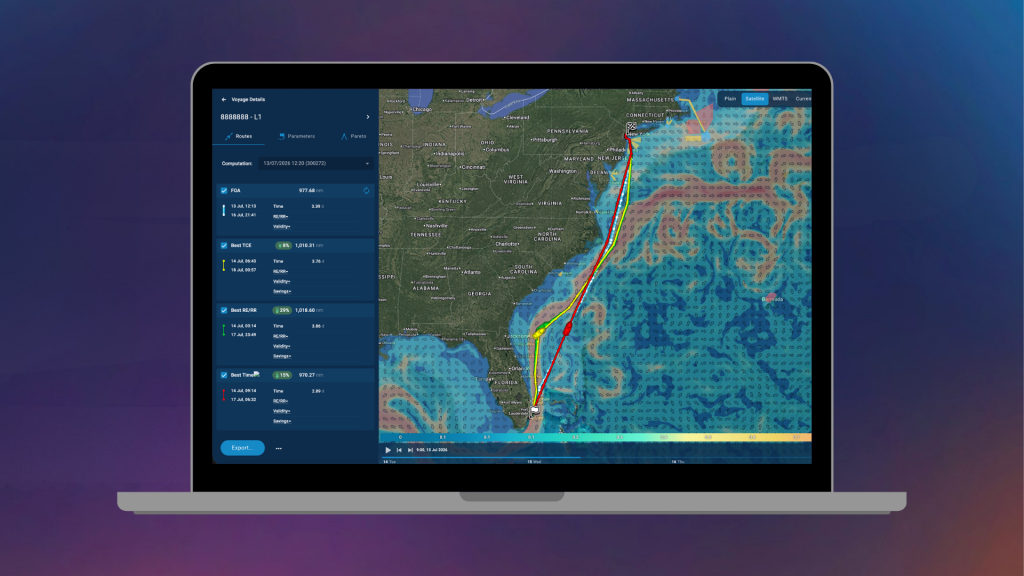
T.VOS is Theyr’s first and only multi-objective voyage optimisation technology. It evaluates fuel, time, arrival, safety, CII, TCE and charter-party considerations within one optimisation process rather than treating them as disconnected calculations.
Its architecture brings together:
- High-fidelity metocean data.
- Navigational information and safety constraints.
- Ship hydrodynamic and performance models.
- Departure, arrival and port information.
- Speed, power and RPM parameters.
- TCE, CII, bunkering and charter-party inputs.
Outputs can include minimum-fuel, best-time and just-in-time options, as well as CII-, TCE-, Charter Party optimum routes and Pareto-efficient alternatives
At its core, T.VOS uses a multi-objective genetic algorithm developed through research involving Theyr, The Alan Turing Institute and the University of Southampton. Rather than returning one supposedly perfect answer, it evaluates hundreds of thousands of voyage alternatives and identifies a set of efficient, executable choices.
The computational scale is not the benefit in itself. The value lies in answering the commercial and operational questions that matter before an instruction is issued:
- Which route lowers fuel without adding unacceptable weather or schedule risk?
- What speed, power or RPM profile reaches the required arrival time with the least energy?
- Can a revised berth window be absorbed through just-in-time arrival?
- How would the minimum-fuel option affect CII, TCE or charter-party performance?
- Is the preferred plan still credible after the latest forecast or vessel update?
Where contractual performance matters, the Dynamic Charter Party Module can bring warranted speed and consumption, weather exclusions and financial clauses into the calculation. This reduces the risk of assessing an emissions-led recommendation separately from the commercial agreement governing the voyage.
For maritime technology providers, the API architecture is particularly valuable. T.VOS can be embedded within voyage-planning, fleet-performance, compliance and operational platforms, placing optimisation inside the user’s established workflow instead of adding another isolated interface.
A weather platform can connect forecast conditions to fuel, timing and commercial decisions. A fleet-performance platform can move from explaining what happened to recommending what should happen next. A compliance platform can incorporate CII and charter-party exposure into live voyage planning instead of reviewing it only after completion.
Turning a recommendation into an executed emissions saving
Technology creates options; operating discipline turns them into fuel and emissions savings.
A practical workflow has five stages:
- Define the required outcome. Establish safety limits, the acceptable arrival range, contractual constraints and the fuel or emissions objective before calculating the voyage.
- Confirm the vessel state. Use the correct draft, displacement, loading condition, fuel and performance model.
- Compare the trade-offs. Review minimum-fuel, just-in-time, best-time and commercial alternatives rather than approving the first route displayed.
- Align ship and shore. Explain the selected route and speed logic, including the circumstances that should trigger re-optimisation.
- Review the executed voyage. Compare predicted and actual fuel, passage time, weather exposure and waiting, then use the variance to improve the next decision.
The most meaningful KPI is not the saving predicted during planning. It is the fuel and emissions avoided in execution while preserving the required safety, arrival and commercial outcome.
T.VOS brings these considerations into a single explainable, multi-objective optimisation process and makes the capability available through an API for easy integration into existing maritime platforms.
For maritime technology providers, this creates an opportunity to move beyond displaying weather, emissions and performance data and help users make better decisions with it.
Frequently Asked Questions (FAQs)
How does voyage optimisation reduce shipping emissions?
Voyage optimisation lowers the energy required to complete a voyage. It combines route selection, vessel-specific performance modelling, speed or RPM management, just-in-time arrival and in-voyage re-optimisation to reduce fuel consumption within safety, ETA and commercial constraints.
How much fuel can voyage optimisation save?
There is no credible universal percentage. Savings depend on the vessel, route, weather, baseline operating profile, arrival flexibility, data quality and whether the recommendation is executed. Any estimate should state its baseline and distinguish modelled potential from verified operational savings.
Does slow steaming always create the lowest-emission voyage?
No. Lower speed often reduces main-engine fuel demand, but excessive slowing can lengthen the voyage, increase auxiliary consumption, miss an arrival window or force a later speed-up. The correct objective is to provide an efficient , an entire-voyage speed profile, within technical and commercial limits.
Can voyage optimisation improve CII?
Voyage optimisation can contribute to better CII performance by reducing fuel use and improving route and speed efficiency. However, CII is calculated and verified annually, so a single optimised voyage cannot guarantee a particular rating.
Can T.VOS be integrated into an existing maritime platform?
Yes. T.VOS is API-first and designed to embed explainable, multi-objective voyage optimisation within existing maritime technology platforms.