
Questions
Bringing new technology to the maritime industry requires more than a sophisticated product. Shipowners, operators and charterers need to understand what it can deliver commercially, how it fits into their operations and why they should trust its recommendations.
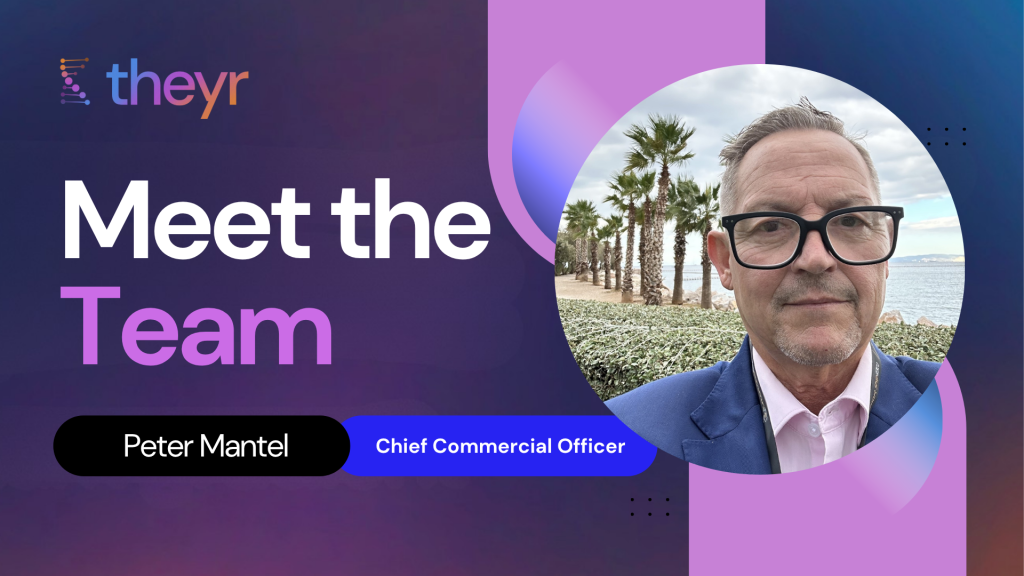
For Peter Mantel, Chief Commercial Officer at Theyr, these considerations are central to growing the business. Having spent his career across shipping and maritime technology, Peter brings extensive industry experience to Theyr’s commercial strategy, connecting the company’s scientific and technical capabilities with the challenges facing its customers.
A key part of that work is broadening the role of T.VOS, from traditional voyage optimisation towards Commercial Decision Intelligence, where route, speed, fuel consumption and contractual obligations are considered alongside their impact on voyage earnings.
In our latest Meet the Team interview, Peter discusses his approach to commercial growth, the changing expectations of maritime technology, what builds customer confidence and why there is still plenty to discover in shipping.
What drew you to Theyr and how has your experience across shipping and maritime technology shaped your approach as Chief Commercial Officer?
Having spent all my career working across shipping and maritime technology, I have seen first-hand both the opportunities and challenges of introducing new technology into what remains a very traditional industry.
What attracted me to Theyr was the sophistication of its technology and, more importantly, its potential to make a genuine difference to how commercial and operational decisions are made.
My approach has always been to start with the customer’s business challenges rather than the technology itself. Shipping is a commercially demanding industry, operating on relatively tight margins, where decisions can have significant financial consequences.
As Chief Commercial Officer, my focus is on bridging the gap between technological innovation and practical commercial value. It’s not simply about what our technology can do, but how it can help customers make better decisions and deliver measurable business outcomes.
You’ve seen maritime technology evolve significantly throughout your career. What feels different about the current wave of digitalisation, AI and decision-support tools compared with previous technology shifts in shipping?
Historically, much of maritime digitalisation has focused on improving access to information, automating processes and increasing operational efficiency.
What’s different today is the opportunity to move beyond providing information towards actively supporting better decisions.
We now have access to enormous volumes of data, significantly greater computing power and increasingly sophisticated optimisation and AI technologies. The challenge is no longer simply collecting or displaying information, but turning it into meaningful, actionable intelligence.
However, I also think we’re entering a more mature phase of maritime digitalisation. The industry is becoming less impressed by technology for technology’s sake. AI is a good example: everyone talks about it, but customers increasingly want to understand what it actually delivers.
The real opportunity lies in combining advanced analytics, optimisation and explainable AI to help people navigate complex commercial and operational trade-offs.
The future isn’t about replacing human judgement with AI. It’s about giving people the intelligence and confidence to make better decisions.
Beyond fuel savings, where do you see voyage optimisation creating the greatest commercial value for shipowners, operators and charterers?
Fuel savings remain important, but I believe the greatest opportunity lies in optimising the overall commercial outcome of a voyage rather than individual performance metrics.
A voyage involves numerous competing objectives: Charter Party obligations, freight economics, Time Charter Equivalent (TCE), arrival windows, bunker costs, emissions, weather risks and schedule reliability.
Optimising fuel consumption in isolation doesn’t necessarily deliver the best commercial result. For example, a slower voyage might reduce bunker consumption but negatively affect TCE, contractual obligations or the next employment opportunity.
This is where multi-objective optimisation becomes particularly valuable.
At Theyr, we are evolving T.VOS towards what we call Commercial Decision Intelligence, allowing operators to evaluate alternative voyage strategies, understand the trade-offs and select the option that best supports their commercial priorities.
Ultimately, it’s about moving the conversation from “What is the most efficient route?” to “What is the best commercial decision for this voyage?”
That distinction is where I believe the next generation of voyage optimisation will create its greatest value.
What do you think is most important when building trust in T.VOS, particularly when it supports decisions with commercial and operational consequences?
Trust is fundamental, particularly in an industry where decisions can affect vessel safety, contractual performance and significant financial outcomes.
For me, trust comes down to three things: reliability, transparency and demonstrable value.
First, the technology must be dependable. Customers need confidence in the quality of the underlying data, the performance models and the consistency of the results.
Second, recommendations must be explainable. Simply presenting an optimised route or an AI-generated recommendation isn’t enough. Operators need to understand why a particular option is being recommended, what assumptions have been made and what trade-offs are involved.
This is one of the reasons I am particularly enthusiastic about our multi-objective optimisation capabilities and our work with the Alan Turing Institute on Explainable AI.
Finally, technology must demonstrate real value in everyday operations, not just in controlled trials or presentations.
I strongly believe that technology should support the decision-maker, not become a black box that expects unquestioning trust.
Giving operators meaningful choices, supported by clear evidence, is central to building long-term confidence in T.VOS.
Outside work, what keeps you curious and engaged with the industry after so many years in maritime?
One of the things I’ve always enjoyed about the maritime industry is that it never stands still, even if it sometimes takes a little longer than we’d like to embrace change!
Shipping is a fascinating combination of global trade, economics, engineering, technology and people. There’s always something new to learn, whether it’s changing trade patterns, emerging technologies or the evolving commercial landscape. I am particularly interested in how technology will continue to transform the way we operate.
I also value the people and relationships across the industry. Maritime remains a remarkably connected community and some of the best ideas come from exchanging perspectives with people who approach challenges differently.
Outside work, apart from the family beach holidays, I enjoy playing chess, which keeps my mind challenged and my strategic thinking sharp. There’s probably a connection between chess and voyage optimisation, both involve evaluating alternatives, anticipating consequences and making the best possible decision with the information available.
I also enjoy staying active and healthy through regular gym sessions, running and a round of golf, while a good sauna is my favourite way to relax and unwind.
For me, it’s about maintaining a balance between curiosity, mental challenges, physical activity and relaxation. After many years in maritime, there is still plenty to discover, new challenges to tackle and opportunities to explore. And, fortunately, even the best optimisation engine needs a little downtime.
For Peter, the opportunity to grow Theyr lies in making advanced voyage optimisation relevant to a wider range of commercial decisions. That means helping customers look beyond individual metrics, evaluate the financial implications of different voyage strategies and understand the reasoning behind each recommendation.
As T.VOS evolves towards Commercial Decision Intelligence, Peter’s focus remains on connecting that technology with the people and businesses that can benefit from it. For Theyr, long-term growth will depend not only on what its optimisation technology can achieve, but on the confidence customers have in using it to make better decisions.